Preprint · 2026

PreferenceScene

Personalized Indoor Scene Synthesis from Feedback

Seongrae NohRyunHa LeeHyeongYeop Kang†
Korea University†Corresponding author

Four simulated users of the test set and the final 3D scenes that PreferenceScene built for them after three turns of feedback. Header: a summary of the user's persona. Below each image: an excerpt of the user's instruction (“…” marks omitted words). Inset: the whole room. Click a scene to follow its interaction turn by turn.

A short instruction rarely conveys the room a person wants. PreferenceScene keeps one value for every design attribute of the room and, after each turn of brief feedback on rendered images, revises the whole plan, including the attributes that the feedback does not name.

00 · Video

The paper in three minutes

best baseline · 45.6
PreferenceScene · 56.6
pAMR (%), Explicit form, test set
PreferenceScene
Narrated overview · one interaction, the task, the method and the results
▶ with sound · 3:06
01 · The task

Preferences that the instruction does not state

Many preferences surface only when a person sees a concrete room. In our task, a system shows a 3D room for three turns; the user sees only rendered images of it and replies with brief free-form feedback and a satisfaction score. The system must then deliver a final room that shows the user's hidden preferences.

4–6/ 10

The input states part of the preferences, or none

Each user holds hidden values for ten design attributes of the room. The persona and instruction state four to six of them in the Explicit form and none in the Implicit form, where they only hint at the person's taste.

Explicit
Implicit
blue: a hidden value stated in the input (example with five)
4–5/ 10

Feedback names only part of the room

An LLM labeller finds that the feedback of one turn names four to five of the ten attributes, and that about a third of the hidden attributes are never named in an interaction.

turn 1
turn 2
turn 3
illustration · orange: named in that turn · hatched: never named
47.8%

Published systems cannot change most parts of the room

Given the hidden preferences directly as text, the five published text-to-scene baselines show at most 47.8% of them in their scenes: they at most pick wall and floor materials from a fixed library. PreferenceScene shows 59.4% in the same condition.
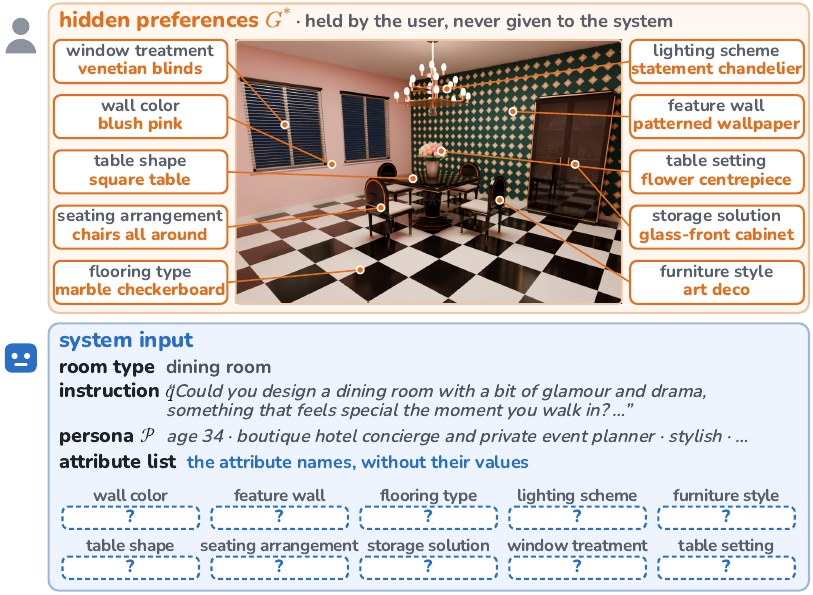
An instance of the benchmark: instruction, persona and the reference scene built from the hidden values.
An instance and its reference scene. The instruction and persona (shortened) are what a system receives. The reference scene is built directly from the hidden values; values such as the blush pink walls and the marble checkerboard floor appear nowhere in the input.

How a scene is scored: pAMR

The perceived attribute match rate is the share of the ten hidden values that a vision-language model (GLM-4.6V-Flash) recovers from two renders of the final scene, a cutaway view from above and an eye-level view.

pAMR = (1/10) · Σa 1[ answer of the evaluator for attribute a = hidden value of a ]

For each attribute, the evaluator answers one multiple-choice question whose options are all values of that attribute, once with the options in the given order and once reversed; pAMR averages the two answers. It is computed on images alone, so it applies to any system that outputs a scene.

reference scenes
89.3
random guess
21.4

Benchmark: ten room types, eight hidden profiles per room type, 320 instances (160 per form). All results on this page are on the 120 test instances per form, with four seeds per instance.
02 · Follow an interaction

Step through a real test interaction

Pick a room type, a form and an interaction, then step from turn 1 to the final scene. You see the renders of each scene, the feedback and score that the simulated user wrote on it, the plan value of each attribute, and which of the user's hidden values the evaluator finds in the scene. Everything below is a stored output of the paper's test runs; nothing is generated in your browser.

03 · Method

An explicit plan of the whole room, revised after every turn

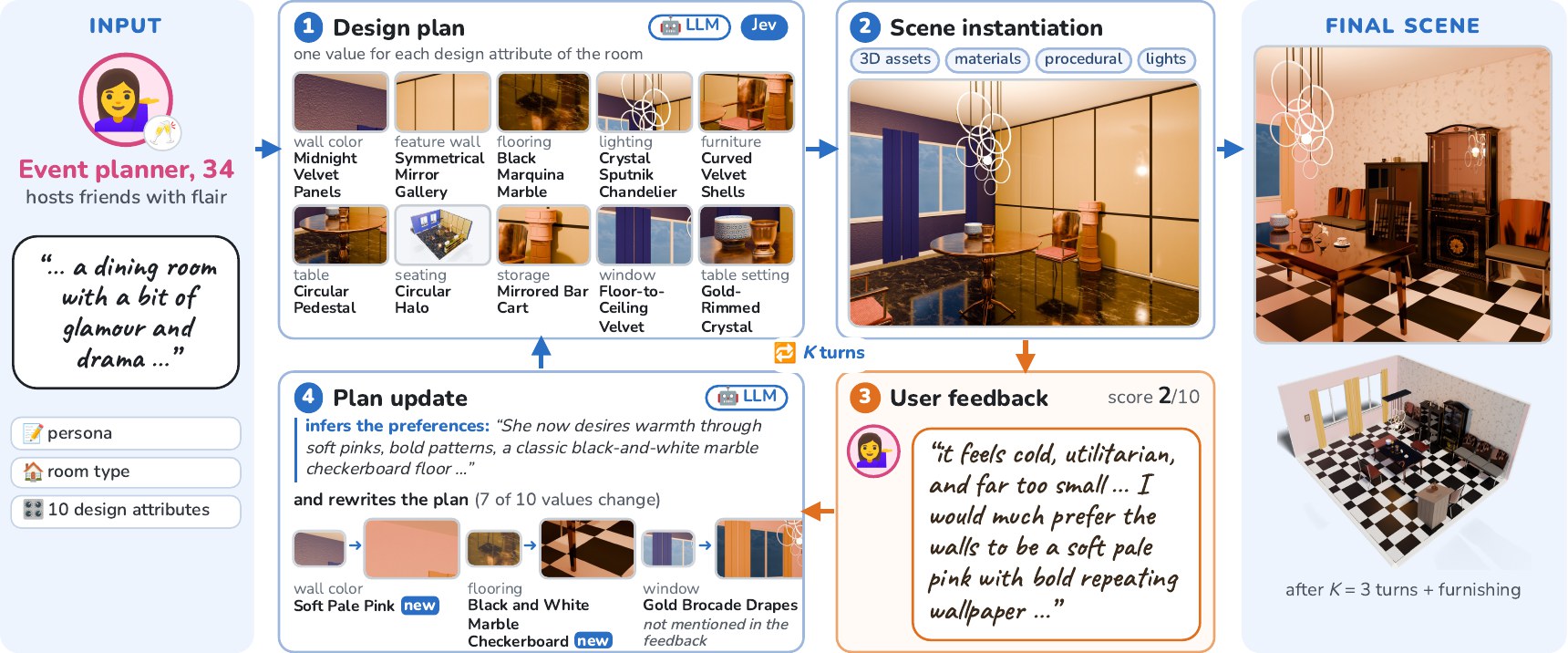
PreferenceScene keeps its estimate of the user's preferences as a plan: one value, a short text such as “pale oak planks”, for each of the ten design attributes of the room. Every change of the plan shows in the room, because scene instantiation builds each value as its own part of the room. The example below is the interaction of the paper's method figure (Implicit form, dining room); every value and text in it is a stored output of that run.

Method figure: design plan, scene instantiation, user feedback, plan update, final scene.
Overview on the first turn of a test interaction (Implicit form). (1) An LLM writes the design plan, one value for each design attribute. (2) Scene instantiation builds the plan as a 3D scene. (3) The user answers with feedback and a score. (4) The LLM infers the user's preferences and rewrites the plan; “new” marks a value outside the candidates. After K = 3 turns, one more LLM call furnishes the final scene.

What each LLM call sees

Candidates (once): room type, instruction and persona; the LLM lists the visible design aspects of the room with twelve candidate values each, six that it considers most likely for this person and six other common choices. Jev, a decision model that returns a probability for every option of a multiple-choice question, assigns each aspect to its most probable attribute if that probability is at least 0.5.

Plan update (after every turn): the input, the candidate sets and, for every earlier turn, the plan, a description of what the scene contained, the feedback and the score. A value is either a candidate or a new value written in the same form.

Furnishing (once): the final plan; the reply adds furniture, objects on furniture tops and pieces for the walls in the free space and lists the object types that each value rules out.

An interaction makes six LLM calls and about 25 requests to Jev. No component reads the hidden values or the value sets of the benchmark.

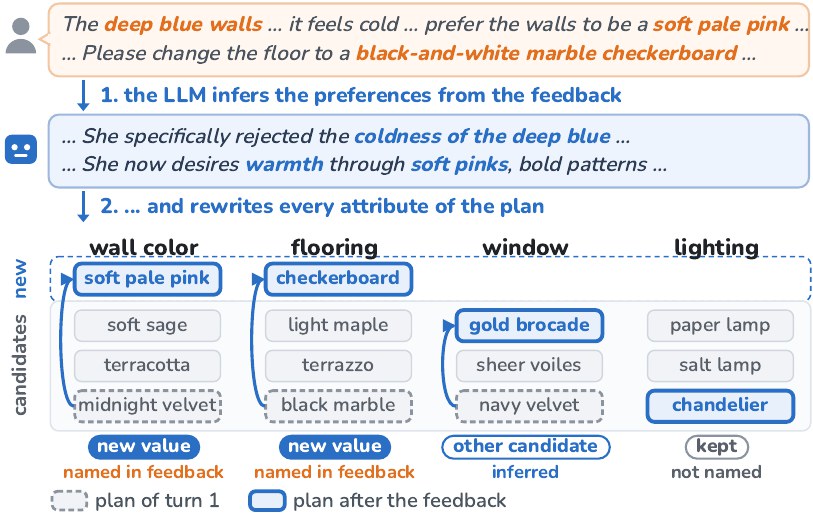
How the plan moves after the feedback of turn 1.
How the plan moves after the feedback of turn 1 (same interaction). The walls and the floor, which the feedback names, receive new values; the window, which it does not name, moves to a candidate that fits the inferred warmth.
04 · Results

Higher preference match than every baseline

Test set: 120 instances per form, four seeds each, three turns. Baselines: five published text-to-scene methods (Holodeck, LayoutGPT, I-Design, LayoutVLM, R3L), each run in the same interaction with the history as input, and Holodeck-Edit, which edits its previous scene in every turn. All systems use the same LLM (Gemma-4-31B), room shells, 6,793 Objaverse assets, renderer and cameras.

pAMR · Explicit form
45.6→56.6
Best baseline (Holodeck-Edit) and PreferenceScene, % of hidden values found in the final scene.
pAMR · Implicit form
43.1→49.6
Best baseline (LayoutVLM) and PreferenceScene.
Turn 1 → final · Implicit
37.5→49.6
+12.1 points over the interaction; the baselines gain at most 9.7.
User study · 720 trials
79.7%
of the answers chose PreferenceScene's scene for the person's preferences; 80.8% for the design.

Preference match of the final scene

pAMR (%), mean ± standard deviation over four seeds. Oracle: one scene generated from the Explicit input and the hidden values, one seed. LayoutGPT: bedrooms and living rooms only.

Match after each turn

pAMR (%) of the scene of each turn and of the final scene, mean over four seeds. Scenes of every turn are scored after the furnishing step.

User study: PreferenceScene against each system

20 participants, 36 trials each. In each trial they saw the final scenes of PreferenceScene and one baseline for the same instance, without names and in random order. Bars: share of answers that chose PreferenceScene, with 95% Wilson intervals. Every rate differs from 50% (two-sided binomial test, Benjamini-Hochberg correction over 12 tests, p < 0.0001).

Scene quality and cost

Ablations

Dining-room and office test instances (24 per form), pAMR (%), mean ± standard deviation over four seeds.

No iteration scores the scene of the initial plan, so its distance to the full method is the whole effect of the feedback. Without older turns, the plan update reads only the latest turn. Without new values, a value outside the candidates is rejected; only about one value in six of the full method's final plans is new (16.2% and 16.6%).

Parts of the room that the feedback never names

pAMR (%) on the hidden attributes that no turn of the interaction names, as found by the LLM labeller.

Other evaluators. With a second evaluator from another model family (Ministral-3-14B), PreferenceScene scores 52.5 (Explicit) and 46.5 (Implicit), against at most 44.9 and 43.0 for the baselines. With an evaluator variant that may answer “not visible”, it scores 47.8 and 40.9, against at most 35.8 and 33.4.

05 · Side by side

Final scenes of five systems for the same user

Seven test instances: the three of the paper's qualitative figure and four more of the supplementary material. Each system ran its own three-turn interaction with the same simulated user; the images show the final scenes. The reference scene is built directly from the user's hidden values, which no system sees. The figures show four of the six baselines; LayoutGPT and Holodeck-Edit are not in them. Click an image to enlarge it.

07 · Cite

BibTeX

@article{noh2026preferencescene, title = {PreferenceScene: Personalized Indoor Scene Synthesis from Feedback}, author = {Noh, Seongrae and Lee, RyunHa and Kang, HyeongYeop}, journal = {arXiv preprint arXiv:2611.32099}, year = {2026} }