Coherent Probabilities for Vision Decision Models
Question 1 is averaged over three option orders; option texts abbreviated. Dashed box: the sum of the two options in question 1, the probability that coherence requires. LLM-as-Jev†: trained on our regrouped questions.
Merging two options should never lower their probability, yet the model gives “upper left or bottom right” 0.31 after giving “upper left” 0.98. Core trains the answers to every regrouping of a question toward one target.
Vision decision models answer a multiple-choice question about an image with one probability per option, and software uses these probabilities directly. The options are mutually exclusive, so a merged option “A or B” should receive the probability of A plus that of B. It receives less.
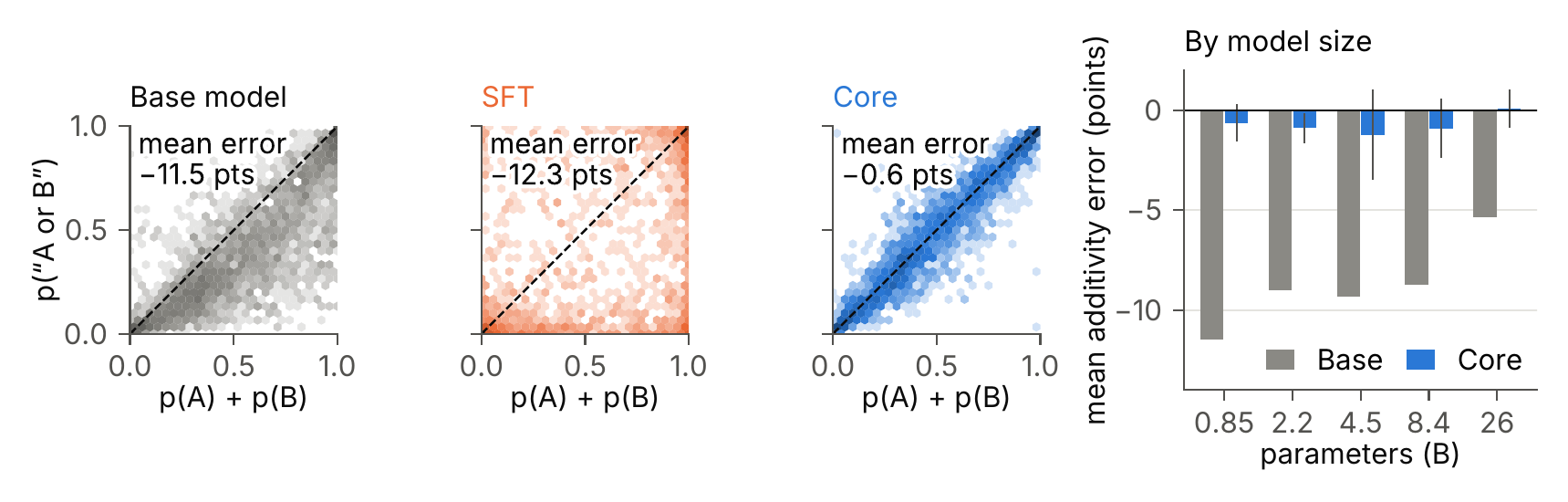
Mean additivity error of the d3-lite base model over the 3,427 merged options of the evaluation set: the merged option’s probability minus the sum of its members’ probabilities.
Mean additivity error of the base model from 0.85B to 26B parameters; Core brings it close to zero at each size.
After supervised fine-tuning (SFT), 32% of merged options still receive at least 0.05 less than their most probable member (base model: 31%).
Pick an item of the evaluation set and ask it the ways we test. The bars are the actual answers of the d3-lite base model and of d3-lite trained with Core. The dashed box is what a coherent model would answer: its own answer to the original question, summed into the new groups.
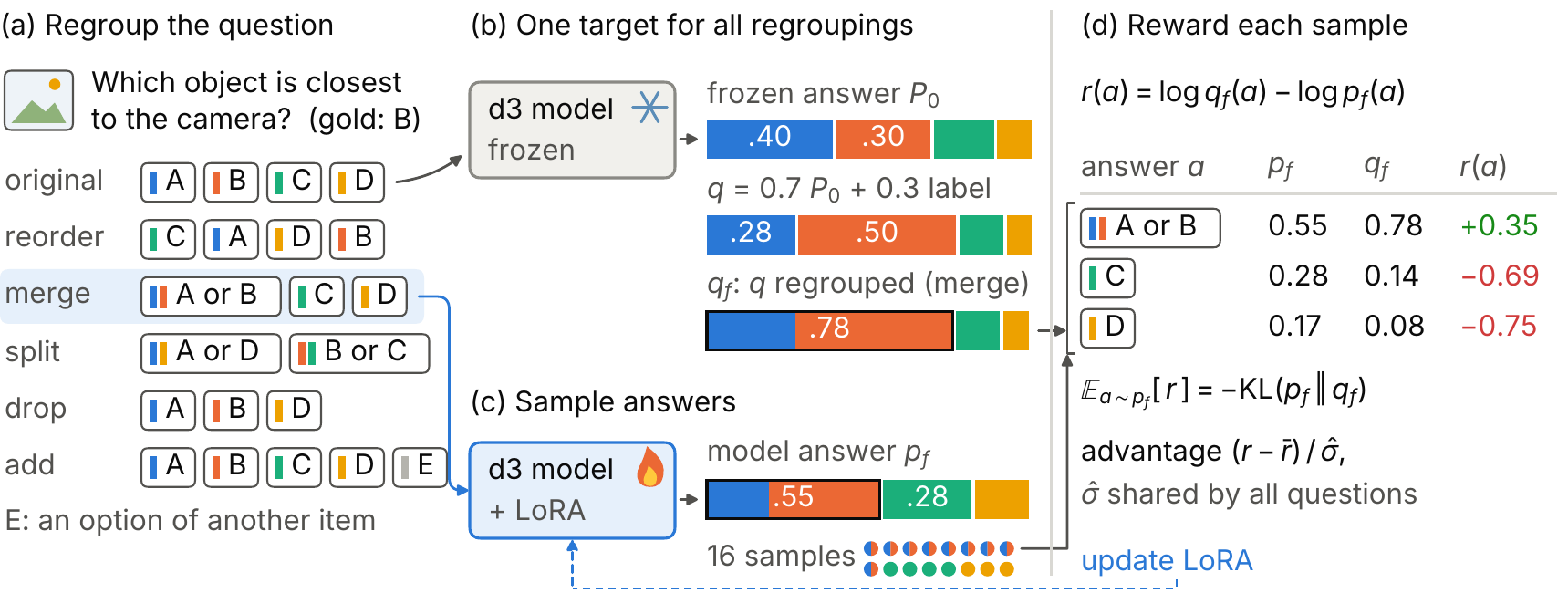
Core (coherence under regrouping) asks each training item with its options regrouped and trains the answers to all these questions toward one target distribution over the original options, summed into each question’s groups. Numbers below are illustrative.

Partition violation: the total variation distance between the answer to a regrouped question and the original answer summed into the same groups (×100, lower is better). Evaluation: 1,050 items from seven benchmarks, 8,250 questions.
Gray: base model. Blue: Core, mean over seeds with 95% interval.
d3-lite. Gray: trained as published. Orange: also trained on our regrouped questions. Blue line: Core.
Training uses “X or Y”. Partition violation on d3-lite (×100).
Trained on 2,308 A-OKVQA items (COCO images, everyday questions), evaluated on our items. Partition violation, d3-lite (×100).
@article{noh2026core,
title = {When ``A or B'' Is Less Likely than A: Coherent Probabilities for Vision Decision Models},
author = {Noh, Seongrae and Hong, SeongEun and Kang, HyeongYeop},
year = {2026},
journal = {arXiv preprint arXiv:2611.30096}
}